For Annalina Van Hercke, hockey was never simply a game she played.
It was where she learned how to lead, communicate, prepare, handle adversity and embrace opportunities. Those lessons began during her five seasons as a goaltender at Concordia University Wisconsin and have continued through coaching, athletic communications and her current role with USA Hockey. Today, Van Hercke is the Manager of Operations for USA Hockey’s Hockey Development Department, where she works with youth and girls hockey, player development camps, national championships, coaches and USA Hockey affiliates across the country.
While she is no longer standing in the crease, she remains very much a part of the game.
“I have so many more opportunities to be involved with it now that I'm not on the ice playing in net myself,” Van Hercke said.
Finding her opportunity at Concordia Wisconsin
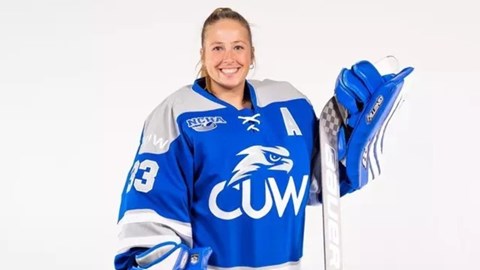
Van Hercke arrived at Concordia Wisconsin with the goal of playing college hockey. Growing up in Colorado and competing at a high level, including with the Chicago Young Americans, Division I hockey had been her goal. When that path did not materialize, Van Hercke found CUW and ultimately found an opportunity that changed
the direction of her life.
“I’m a huge advocate of NCAA Division III just because the route it gave me,” Van Hercke said. “I wouldn't change a single thing that I had in college because it got me
all the stuff where I wanted to in life right now.”
She spent her freshman season as a backup before taking over the starting role and holding it for four seasons. She earned NCHA All-Freshman honors, multiple
NCHA All-Academic selections and NCHA weekly honors while becoming one of the top goaltenders in program history.
But the value of her CUW experience went well beyond statistics. Playing in the NCHA taught Van Hercke that no opponent could be overlooked and that preparation
had to remain consistent every weekend.
“You couldn't take any weekend off,” she said. “Just because an opponent was lower in the standings didn't mean it was going to be a cakewalk.”
That mindset remains with her today. The preparation required to compete in college hockey became a model for how she approaches her professional responsibilities. “I want to prepare for everything that's in front of me,” Van Hercke said. “So that I'm kind of that same level head, that same professionalism in everything that I approach.”
A relationship that evolved
Van Hercke’s relationship with CUW head coach Steve Fabiilli also changed dramatically during her time with the Falcons. As a freshman, she admits she was intimidated by him. But as time progressed through her career, their relationship developed into one built on trust, honesty and mutual respect. Fabiilli was straightforward with Van Hercke about her role. She knew she would back up as a freshman, and after that, she understood the starting job was hers to lose.
“If I had bad days, if I had bad bounces, he understood me as a player and knew that I was going to have the ability to bounce back,” Van Hercke said.
That trust was particularly important for a goaltender, a position that requires the ability to quickly move past mistakes and focus on the next play. Their relationship evolved again after Van Hercke began coaching. Seeing the game from the other side gave her a greater appreciation for the responsibilities of a college coach.
“As a player, you have no idea what it takes to be a head coach,” she said. “You're in your own world as a player. You have no idea what a coach really does.”
Today, Van Hercke and Fabiilli have developed a relationship built on trust and a mutual respect for each other. They exchange ideas about camps and coaching. Their relationship has grown from coach and player into one of professional colleagues who rely on each other to better the the Falcons program and grow the game of hockey.
Van Hercke credits Fabiilli with helping shape the person she has become. “I'm very fortunate that I had that good of a coach in college and he pushed me into the person I want to be.”
More than hockey
One of Van Hercke’s strongest messages today is the value of the NCAA Division III experience. She knows firsthand what it feels like to have NCAA Division I hockey as the goal. But at CUW, she found an opportunity to play significant minutes, develop as a leader and explore interests away from the rink.
“I got to play,” Van Hercke said. “And yes, I could have maybe snuck on a NCAA Division I team, but I wouldn't have played as much as I did at CUW.”
That perspective is something she now shares with young players and families considering their college options. Van Hercke participates in seminars with girls as young as 14 and 15 who are beginning to navigate their hockey pathways. She advocates for NCAA Division III and also discusses ACHA hockey as an option for players seeking a different level of commitment.
Her message is simple: there is more than one path through college hockey, and the right opportunity can open doors that a player may not even know exist. For Van Hercke, NCAA Division III provided not only the chance to compete, but the opportunity to become a better student, athlete, communicator and leader.
From goaltender to leader

Goaltending also gave Van Hercke a unique set of leadership skills. A goaltender sees the ice differently from everyone else and has to communicate with defensemen and forwards while processing the game in real time. Van Hercke believes those experiences continue to influence how she communicates professionally.
“Being a goaltender has given me so much confidence and leadership abilities,” she said. “You just naturally become that leader on the ice.”
She also learned that effective leadership requires controlling emotion and understanding different perspectives. “You need to be mindful of everyone's perspective,”
Van Hercke said. “Everyone has different stakeholders in the situation. And so you want to make sure that you're communicating with something that you've thought it through and you're not making an irrational decision.”
Those lessons are now part of how she works with athletes and coaches at USA Hockey. She also wants young players to understand that the value of sports extends
far beyond what happens on the ice. “The beautiful thing about sports is it teaches kids across the country, regardless of how good they are in the sport, these life skills that they have no idea that they're working on,” she said.
Teamwork, communication, time management and balancing responsibilities are all skills Van Hercke developed as a student-athlete. “Nothing's gonna be harder than being a student-athlete in college with the schedule you have,” she said.
A different perspective on the game
After CUW, Van Hercke spent two seasons coaching at Saint Mary's University in Minnesota. Coaching was not originally part of her plan, but the opportunity forced her to view hockey from a completely different perspective. “I never thought I would ever coach full-time,” she said.
Initially, she questioned whether she was qualified. But the experience became an important part of her professional development. As a former goaltender, she understood the game from the crease. Coaching required her to understand the entire team and, perhaps more importantly, what coaches experience behind the scenes.
“I wasn't just a past player that had playing experience,” Van Hercke said. “All of a sudden I had NCAA coaching experience and I knew the game, I knew what coaches thought, I knew what they had to go through.”
That experience helped prepare her for USA Hockey.
Giving back to the game
Van Hercke’s relationship with USA Hockey began while she was still at CUW. She completed internships with the organization’s player development camps and stayed connected while working and coaching before eventually earning a full-time opportunity. Today, her work includes player development camps, national championships, youth and girls hockey, coaching education and events across the country. The opportunity has also allowed her to contribute to the growth of a sport that means so much to her.
USA Hockey registered more than 100,000 female players last year, according to Van Hercke, and she is excited to be part of the continued growth of girls hockey alongside the emergence of the Professional Women’s Hockey League.
“One of my favorite things about my job is that I can share the love and passion that I have for the sport and help create these environments for these players to fall in
love with the sport at a young age,” she said.
Van Hercke works directly with young players but also helps educate coaches through coaching clinics and female-specific programming. Her goal is to help create environments where girls can develop as hockey players and as people. Whether a player's dream is the PWHL, the Olympics, NCAA Division I, NCAA Division III or simply enjoying the sport, Van Hercke wants them to have the opportunity to find where hockey can take them.
“It's really cool that I have an opportunity to be on the ice with some of those players and create that experience.”
The next chapter
Van Hercke is still early in her professional career, but she already knows hockey will remain at its center. She hopes to continue growing within USA Hockey, particularly in player development, while keeping an eye toward a future in hockey operations.
“It's kind of hard to imagine working in any other industry once you're in it,” she said.

Her journey began with a decision to attend Concordia Wisconsin when NCAA Division I hockey did not work out as planned. It grew through five seasons in the NCHA, where she learned how to compete, prepare, communicate and recover from adversity. It expanded through athletic communications and coaching, eventually leading her to USA Hockey. Now, from a different side of the rink, she is helping young players discover what hockey might become for them.
Her advice is the same philosophy that has guided her own career: take the opportunity. “The worst thing they're going to do is say no,” Van Hercke said.
She lived that philosophy throughout college, pursuing internships, working games, trying coaching and taking opportunities that did not necessarily fit the original plan. “Take as many opportunities
as you can while you have it,” she said. “Especially while you're in school.”
For Van Hercke, the path from CUW to USA Hockey was not a straight line. It was built one opportunity at a time. And while her playing career ended when she left the crease, her hockey career was only beginning.